

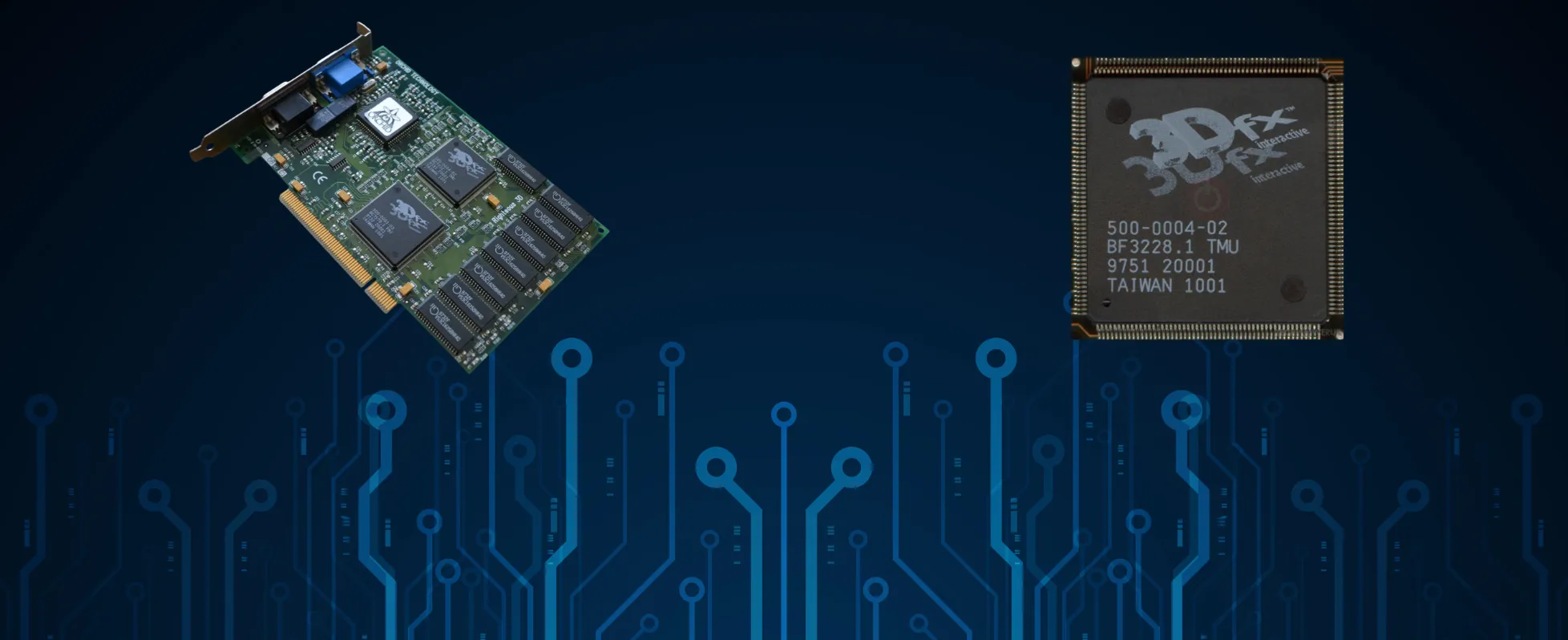
The 3dfx Voodoo Graphics (often simply called Voodoo1) is one of the most iconic and influential 3D accelerator cards of the late 1990s. Released in 1996, it marked a turning point in PC gaming by delivering true hardware‑accelerated 3D graphics at a time when most games relied fully on software rendering.
The card features a dual‑chip architecture with separate FBI (Frame Buffer Interface) and TMU (Texture Mapping Unit) processors, paired with 4 MB EDO RAM (2 MB frame buffer + 2 MB texture memory). Unlike later GPUs, the Voodoo1 operates strictly as a 3D-only pass-through accelerator, connecting to a 2D graphics card via a small internal VGA cable.
One of its greatest strengths was support for Glide, 3dfx’s proprietary low-level graphics API, which provided excellent performance and image quality in many of the era’s biggest PC titles. Games like Quake, Tomb Raider, Need for Speed II SE, and Unreal truly showcased what the Voodoo1 could do, bringing smooth frame rates, filtered textures, and impressive lighting effects that were far ahead of software rendering.
Even today, the Voodoo Graphics remains a beloved card in the retro‑hardware community thanks to its historical impact, distinctive look, and compatibility with classic Glide‑enabled games. For collectors and enthusiasts, it represents the beginning of one of the most important eras in PC gaming graphics.
- Release Year
- 1996
- Manufacturer
- 3dfx
- Model
- Voodoo Graphics
- Code Name
- SST-1
- Texture Fill Rate
- 50 MTexels/s
- Chip Clock
- 50 MHz
- Memory Clock
- 50 MHz
- RAM
- 4-6 MByte
Comments