

Old news got deleted from the forum. I just transferred some to the new News area to see how it looks like and the other ones I simply removed.
Posts by ISeeTWizard
-
-
Dear Community,
We have some exciting news regarding the layout and organization of our forum!
Up until now, all of our News articles and Reviews have been posted as traditional forum entries. While this worked well for a long time, we wanted a cleaner, more professional, and easier-to-browse way to showcase this content.
🛠️ What is Changing?
To achieve this, we have integrated two brand-new plugins into the site. Moving forward, News and Reviews will be moved out of the standard forum threads and into their own dedicated, custom-designed sections.
Note: Everything stays entirely within the forum ecosystem! You won't need to log into an external site or navigate away. They just have their own specialized, beautiful view now, accessible right from the main navigation bar.
🔗 Explore the New Sections
You can check out the new systems right now via the main menu, or by using the direct links below:
- 📰 Our Dedicated News System: forums.iseet.fans/news/
- ⭐ Our Dedicated Reviews System: forums.iseet.fans/reviews/
We are currently in the process of organizing this transition, and we hope these dedicated spaces will make reading, finding, and engaging with our major updates and reviews much more enjoyable.
Thank you for being a part of the community, and let us know what you think of the new look in the comments below! 🙌
Best regards,
The Admin Team
-
I also created a small script to activate Office 2024 GVLK with your KMS server with a better feedback in case of an error or success.
PowerShell
Display More# Start the stopwatch at the very beginning $Stopwatch = [System.Diagnostics.Stopwatch]::StartNew() # 1. Enforce PowerShell as Administrator if (-not ([Security.Principal.WindowsPrincipal][Security.Principal.WindowsIdentity]::GetCurrent()).IsInRole([Security.Principal.WindowsBuiltInRole]::Administrator)) { Write-Error "Please run this PowerShell script as an Administrator!" Exit } Write-Host "=== Starting Office KMS Activation ===" -ForegroundColor Cyan # 2. Locate the Office installation directory dynamically $OfficePath = "" $PossiblePaths = @( "C:\Program Files\Microsoft Office\root\Office16", "C:\Program Files\Microsoft Office\Office16", "C:\Program Files (x86)\Microsoft Office\root\Office16", "C:\Program Files (x86)\Microsoft Office\Office16" ) foreach ($Path in $PossiblePaths) { if (Test-Path "$Path\ospp.vbs") { $OfficePath = $Path break } } if ([string]::IsNullOrEmpty($OfficePath)) { Write-Host "===================================================================" -ForegroundColor Red Write-Error "ERROR: ospp.vbs was not found! Is Office actually installed?" Write-Host "===================================================================" -ForegroundColor Red Exit } Set-Location -Path $OfficePath # 3. Inject KMS Key and Host Server Write-Host "Configuring KMS Client Key and Host..." -ForegroundColor Yellow $null = cscript //nologo ospp.vbs /inpkey:XJ2XN-FW8RK-P4HMP-DKDBV-GCVGB $null = cscript //nologo ospp.vbs /sethst:your.kms.server # 4. Trigger KMS Activation Write-Host "Activating Office against KMS server..." -ForegroundColor Yellow $null = cscript //nologo ospp.vbs /act # 5. Capture and parse activation status Write-Host "Checking activation status..." -ForegroundColor Yellow $StatusOutput = cscript //nologo ospp.vbs /dstatus # Initialize tracking variables $IsLicensed = $false $IsGrace = $false $RemainingDays = "" foreach ($Line in $StatusOutput) { if ($Line -match "LICENSE STATUS:\s+---LICENSED---") { $IsLicensed = $true } elseif ($Line -match "LICENSE STATUS:\s+---OOB_GRACE---|---REMAINING_GRACE---") { $IsGrace = $true } elseif ($Line -match "REMAINING GRACE:\s+(\d+)\s+days") { $RemainingDays = $Matches[1] } } # Stop the stopwatch right after capturing the status $Stopwatch.Stop() $ElapsedTime = "{0:mm}m {0:ss}s" -f $Stopwatch.Elapsed # 6. Big, dumb-user-friendly visual output Write-Host "" if ($IsLicensed) { Write-Host "===================================================================" -ForegroundColor Green Write-Host " SUCCESS: Office 2024 is FULLY ACTIVATED and genuine! " -ForegroundColor Green Write-Host " Status : LICENSED (180 days standard KMS lease)" -ForegroundColor Green Write-Host " Execution Time: $ElapsedTime" -ForegroundColor Green Write-Host "===================================================================" -ForegroundColor Green } elseif ($IsGrace) { Write-Host "===================================================================" -ForegroundColor DarkYellow Write-Host " WARNING: Office is running in GRACE MODE! " -ForegroundColor DarkYellow Write-Host " Status : Temporary Activation " -ForegroundColor DarkYellow if ($RemainingDays) { Write-Host " Remaining Time: $RemainingDays Days" -ForegroundColor DarkYellow } Write-Host " Execution Time: $ElapsedTime" -ForegroundColor DarkYellow Write-Host "===================================================================" -ForegroundColor DarkYellow } else { Write-Host "===================================================================" -ForegroundColor Red Write-Host " ERROR: Office Activation FAILED! " -ForegroundColor Red Write-Host " Execution Time: $ElapsedTime" -ForegroundColor Red Write-Host "===================================================================" -ForegroundColor Red $StatusOutput | Findstr /I "ERROR LICENSE" }Pay attention that you have to adapt the KMS server host in this file!
-
Here a small script to install Office 2024 GVLK with different checks during install
PowerShell
Display More# Start the stopwatch at the very beginning $Stopwatch = [System.Diagnostics.Stopwatch]::StartNew() # 1. Enforce PowerShell as Administrator if (-not ([Security.Principal.WindowsPrincipal][Security.Principal.WindowsIdentity]::GetCurrent()).IsInRole([Security.Principal.WindowsBuiltInRole]::Administrator)) { Write-Error "Please run this PowerShell script as an Administrator!" Exit } # Dynamically determine the directory where this script is located $CurrentDir = $PSScriptRoot if ([string]::IsNullOrEmpty($CurrentDir)) { $CurrentDir = Get-Location } Write-Host "=== Starting Office Installation from $CurrentDir ===" -ForegroundColor Cyan # 2. Check if setup.exe exists if (-not (Test-Path "$CurrentDir\setup.exe")) { Write-Error "ERROR: setup.exe was not found in $CurrentDir!" Exit } # 3. Check if configuration.xml exists $ConfigFile = "$CurrentDir\configuration.xml" if (-not (Test-Path $ConfigFile)) { Write-Error "ERROR: configuration.xml was not found in $CurrentDir!" Exit } # 4. Check if local Office installation source data exists $DataFolder = "$CurrentDir\Office\Data" if (-not (Test-Path $DataFolder)) { Write-Error "ERROR: Local Office installation files are missing!" Exit } # 5. Trigger the installation using the local setup.exe Write-Host "Starting Office installation in the background..." -ForegroundColor Yellow Write-Host "(This might take a few minutes. Do NOT close this window.)" -ForegroundColor DarkGray $Process = Start-Process -FilePath "$CurrentDir\setup.exe" -ArgumentList "/configure `"$ConfigFile`"" -PassThru # Give the system 5 seconds to fully spawn the installation window Start-Sleep -Seconds 5 # Actively loop and wait ONLY for active installer engines Write-Host "Monitoring background installer tasks..." -ForegroundColor DarkGray while (Get-Process -Name "setup", "officeinstaller" -ErrorAction SilentlyContinue) { Start-Sleep -Seconds 3 } # Stop the stopwatch before printing the final banner $Stopwatch.Stop() $ElapsedTime = "{0:mm}m {0:ss}s" -f $Stopwatch.Elapsed # 6. Evaluate the final result $OfficeCheck1 = Test-Path "C:\Program Files\Microsoft Office\root\Office16\WINWORD.EXE" $OfficeCheck2 = Test-Path "C:\Program Files (x86)\Microsoft Office\root\Office16\WINWORD.EXE" if ($OfficeCheck1 -or $OfficeCheck2) { Write-Host "" Write-Host "===================================================================" -ForegroundColor Green Write-Host " SUCCESS: Office has been successfully installed!" -ForegroundColor Green Write-Host " Total Execution Time: $ElapsedTime" -ForegroundColor Green Write-Host "===================================================================" -ForegroundColor Green } else { Write-Host "" Write-Host "===================================================================" -ForegroundColor Red Write-Host " ERROR: The Office installation process finished, but Office apps" -ForegroundColor Red Write-Host " could not be found on the system. Please check ODT logs." -ForegroundColor Red Write-Host " Total Execution Time: $ElapsedTime" -ForegroundColor Red Write-Host "===================================================================" -ForegroundColor Red }Here is the XML file used for the download and/or installation - name it configuration.xml
-
Sometimes you have as example Office 365 installed but with several language packs and proofing tools etc. Than it is a pain in the ass to remove every single installation.
A more fast and smooth way provides this script here
PowerShell
Display More# Start the stopwatch at the very beginning $Stopwatch = [System.Diagnostics.Stopwatch]::StartNew() # 1. Enforce PowerShell as Administrator if (-not ([Security.Principal.WindowsPrincipal][Security.Principal.WindowsIdentity]::GetCurrent()).IsInRole([Security.Principal.WindowsBuiltInRole]::Administrator)) { Write-Error "Please run this PowerShell script as an Administrator!" Exit } # Dynamically determine the directory where this script is located $CurrentDir = $PSScriptRoot if ([string]::IsNullOrEmpty($CurrentDir)) { $CurrentDir = Get-Location } Write-Host "=== Starting Office Uninstall from $CurrentDir (All Languages) ===" -ForegroundColor Cyan # 2. Check if setup.exe exists in the current directory if (-not (Test-Path "$CurrentDir\setup.exe")) { Write-Error "ERROR: setup.exe was not found in $CurrentDir!" Exit } # 3. Create the XML configuration file dynamically $XmlContent = @" <Configuration> <Remove All="TRUE"> <Language ID="all" /> </Remove> <Property Name="FORCEAPPSHUTDOWN" Value="TRUE" /> <Display Level="None" AcceptEULA="TRUE" /> </Configuration> "@ $XmlFile = "$CurrentDir\uninstall_office.xml" $XmlContent | Out-File -FilePath $XmlFile -Encoding ascii # 4. Trigger the uninstallation Write-Host "Uninstalling Office in the background. Please wait..." -ForegroundColor Yellow Write-Host "(Any open Office applications will be closed automatically.)" -ForegroundColor DarkGray $Process = Start-Process -FilePath "$CurrentDir\setup.exe" -ArgumentList "/configure `"$XmlFile`"" -Wait -PassThru # Stop the stopwatch before printing the final banner $Stopwatch.Stop() $ElapsedTime = "{0:mm}m {0:ss}s" -f $Stopwatch.Elapsed # 5. Evaluate the result and Exit Code if ($Process.ExitCode -eq 0) { Write-Host "" Write-Host "===================================================================" -ForegroundColor Green Write-Host " SUCCESS: Office and all language packs have been removed! " -ForegroundColor Green Write-Host " Total Execution Time: $ElapsedTime" -ForegroundColor Green Write-Host "===================================================================" -ForegroundColor Green Remove-Item -Force $XmlFile -ErrorAction SilentlyContinue } else { Remove-Item -Force $XmlFile -ErrorAction SilentlyContinue $OfficeService = Get-Service -Name "ClickToRunSvc" -ErrorAction SilentlyContinue $OfficeRegistry = Test-Path "HKLM:\SOFTWARE\Microsoft\Office\ClickToRun" if (-not $OfficeService -and -not $OfficeRegistry) { Write-Host "" Write-Host "Notice: No installed Office product was detected on this system." -ForegroundColor DarkYellow Write-Host "The uninstallation process has been skipped." -ForegroundColor DarkYellow Write-Host "Total Execution Time: $ElapsedTime" -ForegroundColor DarkYellow } else { Write-Error "An error occurred during the Office uninstallation. ExitCode: $($Process.ExitCode)" Write-Host "Total Execution Time: $ElapsedTime" -ForegroundColor Red } } -
The recipes area is now open but pay attention that most of the recipes will be in German (some may be in French) and not in English!
I live in Luxembourg and so German or French is more convenient for recipes for me.Simply use a translator tool or ask if you need to have more info

-
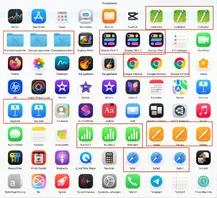
Sometimes it may happen that after you reinstall your Mac but don't recover a backup icons suddenly 2-3 times.
This is a known bug and can easily be fixed with a simple command.Open the Terminal app and enter this
If this doesn't directly work you may switch off your Mac (REALLY SWITCH OFF) and wait for about 30 seconds. Than you can switch on again.
If that doesn't help you may really have multiple copies of the apps in your application folder.

-
External Content www.youtube.comContent embedded from external sources will not be displayed without your consent.Through the activation of external content, you agree that personal data may be transferred to third party platforms. We have provided more information on this in our privacy policy.
-
External Content www.youtube.comContent embedded from external sources will not be displayed without your consent.Through the activation of external content, you agree that personal data may be transferred to third party platforms. We have provided more information on this in our privacy policy.
-
Microsoft is a global technology company specializing in software, hardware, cloud services, and digital technologies, headquartered in Redmond. The company is best known for products such as Windows, Microsoft Office, and cloud platforms like Azure. It has grown into one of the world’s largest technology companies and software developers.
Microsoft was founded on April 4, 1975, in Albuquerque by [definition='4','0']Bill Gates[/definition] and Paul Allen. The company later moved to Bellevue and eventually established its headquarters in Redmond. The name Microsoft combines the words microcomputer and software.
Microsoft’s early success came from developing a BASIC interpreter, followed by the release of MS-DOS in 1981 for IBM-compatible PCs. During the 1990s, Windows and Microsoft Office became dominant products in the personal computer market, helping establish Microsoft as a leading force in the technology industry.
Leadership evolved over time, with Steve Ballmer serving as CEO from 2000 to 2014, followed by Satya Nadella, who has led the company since 2014 and overseen a major expansion into cloud computing and artificial intelligence.
-
Active Directory (AD) is the directory service used in Microsoft Windows Server environments to centrally manage users, devices, permissions, and network resources. Starting with Windows Server 2008, its core functionality became known as Active Directory Domain Services (AD DS).
A directory service works similarly to a digital phone book, storing and organizing information about network objects and their relationships. These objects can include:
- Users – employee accounts and login credentials
- Groups – collections of users with shared permissions
- Computers and servers – devices connected to the network
- Printers, scanners, and shared folders – accessible resources
- Services and applications – systems requiring authentication
Active Directory allows organizations to structure networks according to their business hierarchy or physical locations, making administration more efficient. Administrators can create policies, assign permissions, and monitor resources from a central location.
One of AD’s key functions is access control. For example, administrators can decide which users may access certain files, applications, or printers, ensuring security and restricting sensitive information to authorized personnel only. This centralized authentication and authorization model is a core reason why Active Directory remains widely used in enterprise IT environments.
-
Microsoft Windows, commonly known as Windows, began as a graphical user interface developed by Microsoft to run on top of MS-DOS. Over time, it evolved into a family of standalone operating systems and became one of the most widely used platforms for personal computers worldwide.
Early versions of Windows functioned as graphical extensions to DOS, similar to systems such as GEM or PC/GEOS. Starting with Windows 95, Microsoft introduced major improvements including a redesigned kernel, the 32-bit Win32 API, and built-in internet support. These systems, including Windows 98 and Windows ME, became known collectively as the Windows 9x family.
At the same time, Microsoft developed Windows NT, led by David Cutler and based on concepts from the VMS operating system. Because of its greater stability and technical capabilities, Windows NT eventually replaced Windows 9x. Since Windows XP, all desktop versions of Windows have been built on the Windows NT architecture.
Today, Windows powers a wide range of devices including desktop PCs, laptops, servers, embedded systems, retail terminals, industrial equipment, and specialized automotive systems. The name Windows comes from the graphical interface design, where applications appear as rectangular “windows” on the screen.
-
[definition='4','0']Bill Gates[/definition] is an American entrepreneur, programmer, and philanthropist best known for co-founding Microsoft with Paul Allen in 1975. His role in building Microsoft helped make him one of the wealthiest individuals in the world, with an estimated fortune exceeding $100 billion.
In 2008, Gates stepped away from Microsoft’s day-to-day operations to focus primarily on philanthropy through the Bill & Melinda Gates Foundation, which he co-founded. Through initiatives such as the The Giving Pledge, he committed to donating the majority of his wealth and had already contributed tens of billions of dollars to charitable causes. Gates has pledged to give away 95% of his fortune during his lifetime, concentrating on global health, education, and poverty reduction.
-
Paul Allen was an American entrepreneur best known for co-founding Microsoft with [definition='4','0']Bill Gates[/definition]. He served on the company’s board from 1975 to 1983 before focusing on business investments, art collecting, and ownership of professional sports teams in North America.
Allen was widely regarded as a visionary of the connected digital world, recognizing early the importance of networked technologies. In 2015, he was ranked among the world’s wealthiest individuals by Forbes, with an estimated net worth of $17.5 billion, placing him 51st globally. Beyond technology, he became known for philanthropy, scientific projects, and support for sports and the arts.
-
A Disk Operating System (DOS) refers to an operating system primarily designed to manage data stored as files on rotating storage devices such as floppy disks and hard drives. Its main purpose is organizing, accessing, and controlling stored information.
Today, the term DOS is used almost exclusively as a synonym for MS-DOS, the operating system that dominated personal computing and was one of the most widely used systems until the late 1990s.
-
A personal computer (PC) is a versatile computer designed for everyday individual use. Unlike earlier computers, which were mainly operated by experts, technicians, or scientists, PCs made computing accessible to the general public. The concept emerged in the 1970s and was driven by hacker culture, with affordable pricing and ease of use becoming key factors in its success. Since the first implementations in 1976, PCs have played a major role in what many describe as the computer revolution.
PCs are microcomputers, differing from larger systems such as minicomputers or mainframes. They appear in forms including desktops, laptops, and tablets, and can run operating systems like Windows, macOS, Android, or Unix. Their use ranges from home computing to professional workstations, with high-performance workstations designed for demanding computing tasks.
Although the term “personal computer” existed earlier, from 1981 onward the abbreviation “PC” became strongly associated with the IBM PC and compatible systems. This connection was reinforced by IBM’s marketing and linked to x86 processors and operating systems such as DOS and Windows. In some cases, “PC” is still associated specifically with traditional x86 desktop computers, despite newer PC formats such as tablet devices.
-
A hard disk drive (HDD), hard disk, hard drive, or fixed disk[b] is an electro-mechanical data storage device that stores and retrieves digital data using magnetic storage and one or more rigid rapidly rotating platters coated with magnetic material. The platters are paired with magnetic heads, usually arranged on a moving actuator arm, which read and write data to the platter surfaces. Data is accessed in a random-access manner, meaning that individual blocks of data can be stored and retrieved in any order. HDDs are a type of non-volatile storage, retaining stored data even when powered off. Modern HDDs are typically in the form of a small rectangular box.
Introduced by IBM in 1956, HDDs were the dominant secondary storage device for general-purpose computers beginning in the early 1960s. HDDs maintained this position into the modern era of servers and personal computers, though personal computing devices produced in large volume, like cell phones and tablets, rely on flash memory storage devices. More than 224 companies have produced HDDs historically, though after extensive industry consolidation most units are manufactured by Seagate, Toshiba, and Western Digital. HDDs dominate the volume of storage produced (exabytes per year) for servers. Though production is growing slowly (by exabytes shipped), sales revenues and unit shipments are declining because solid-state drives (SSDs) have higher data-transfer rates, higher areal storage density, somewhat better reliability, and much lower latency and access times.
The revenues for SSDs, most of which use NAND flash memory, slightly exceed those for HDDs. Flash storage products had more than twice the revenue of hard disk drives as of 2017. Though SSDs have four to nine times higher cost per bit, they are replacing HDDs in applications where speed, power consumption, small size, high capacity and durability are important. Cost per bit for SSDs is falling, and the price premium over HDDs has narrowed.
The primary characteristics of an HDD are its capacity and performance. Capacity is specified in unit prefixes corresponding to powers of 1000: a 1-terabyte (TB) drive has a capacity of 1,000 gigabytes (GB; where 1 gigabyte = 1 billion (109) bytes). Typically, some of an HDD's capacity is unavailable to the user because it is used by the file system and the computer operating system, and possibly inbuilt redundancy for error correction and recovery. Also there is confusion regarding storage capacity, since capacities are stated in decimal gigabytes (powers of 1000) by HDD manufacturers, whereas the most commonly used operating systems report capacities in powers of 1024, which results in a smaller number than advertised. Performance is specified by the time required to move the heads to a track or cylinder (average access time) adding the time it takes for the desired sector to move under the head (average latency, which is a function of the physical rotational speed in revolutions per minute), and finally the speed at which the data is transmitted (data rate).
The two most common form factors for modern HDDs are 3.5-inch, for desktop computers, and 2.5-inch, primarily for laptops. HDDs are connected to systems by standard interface cables such as PATA (Parallel ATA), SATA (Serial ATA), USB or SAS (Serial Attached SCSI) cables.
-
Gaming is the practice of playing video games. The term may also refer to betting, especially online. This article focuses just on the term when it refers to video games.
Somebody who is gaming may be playing video or electronic games using a console, mobile phone, VR (virtual reality) goggles, or computer. The gamer is typically a regular player who enjoys electronic games as a hobby. There are also professional gamers; they make a living in the world of esports. In fact, some of them are now millionaires.
The term esports is short for electronic sports, in which gamers compete online or in giant arenas. Prize money sizes have been increasing dramatically over the past few years.
-
External Content youtu.beContent embedded from external sources will not be displayed without your consent.Through the activation of external content, you agree that personal data may be transferred to third party platforms. We have provided more information on this in our privacy policy.
-
External Content youtu.beContent embedded from external sources will not be displayed without your consent.Through the activation of external content, you agree that personal data may be transferred to third party platforms. We have provided more information on this in our privacy policy.
-
External Content youtu.beContent embedded from external sources will not be displayed without your consent.Through the activation of external content, you agree that personal data may be transferred to third party platforms. We have provided more information on this in our privacy policy.
-
External Content youtu.beContent embedded from external sources will not be displayed without your consent.Through the activation of external content, you agree that personal data may be transferred to third party platforms. We have provided more information on this in our privacy policy.
-
External Content youtu.beContent embedded from external sources will not be displayed without your consent.Through the activation of external content, you agree that personal data may be transferred to third party platforms. We have provided more information on this in our privacy policy.
-
External Content youtu.beContent embedded from external sources will not be displayed without your consent.Through the activation of external content, you agree that personal data may be transferred to third party platforms. We have provided more information on this in our privacy policy.
-
External Content youtu.beContent embedded from external sources will not be displayed without your consent.Through the activation of external content, you agree that personal data may be transferred to third party platforms. We have provided more information on this in our privacy policy.