

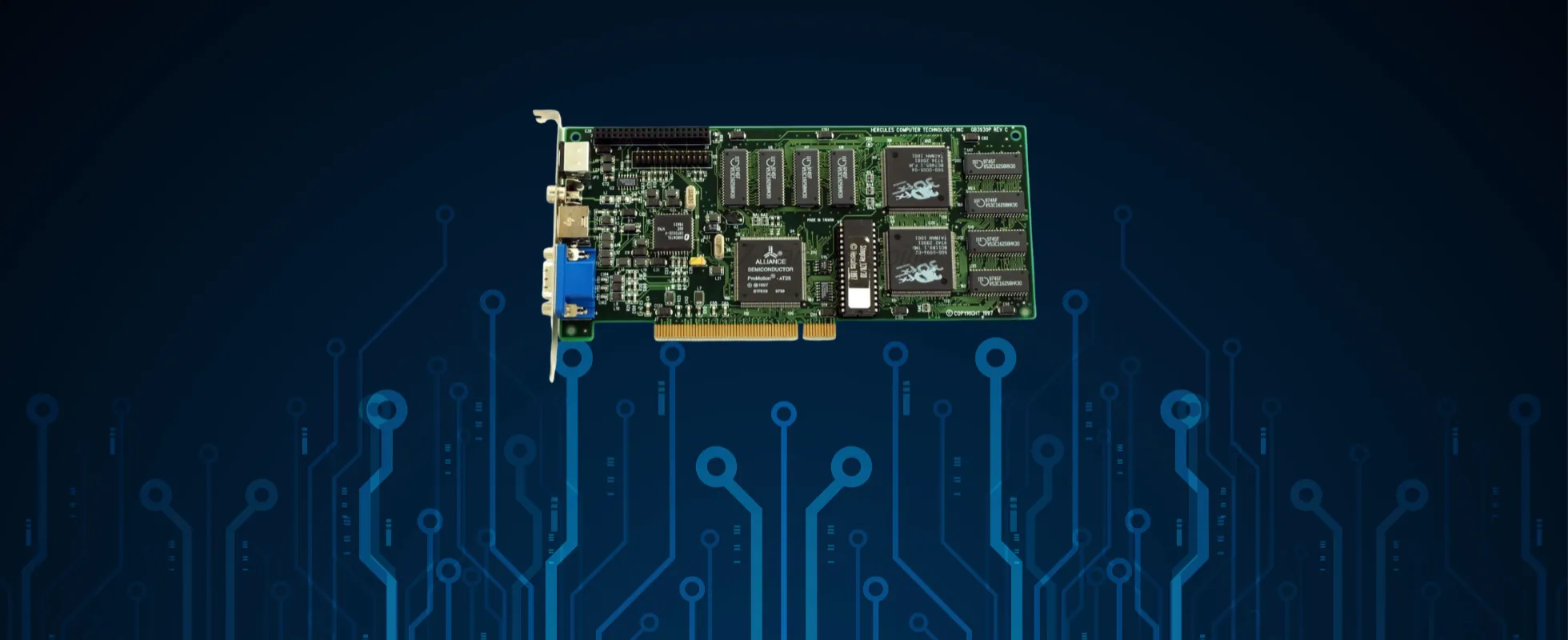
The 3dfx Voodoo Rush was an early 3D graphics accelerator released in 1997, designed as a cheaper, all-in-one alternative to the original Voodoo Graphics cards. Unlike the first Voodoo cards, which required a separate 2D graphics card, Voodoo Rush combined 2D and 3D rendering on a single card.
Main characteristics
- Manufacturer: Developed by 3dfx Interactive with partner companies producing the cards.
- Architecture: Combined:
- a 3dfx Voodoo Graphics (3D chip), and
- a separate 2D VGA controller from another manufacturer (commonly Alliance or Macronix).
- Memory: Usually 4 MB to 8 MB EDO RAM
- API support:
- Glide (3dfx’s proprietary API — often gave the best performance)
- Direct3D
- Some OpenGL support via mini-drivers
- Connection: PCI slot
- Typical resolutions:
- 3D gaming around 640×480
- Higher resolutions possible for desktop use
Why it was important
The Voodoo Rush aimed to make 3D gaming simpler by eliminating the need for:
- a normal 2D graphics card, plus
- a separate Voodoo accelerator card with a pass-through cable.
That made PCs cheaper and easier to build.
Why it wasn’t very successful
Despite the idea, the Voodoo Rush often performed worse than the original Voodoo Graphics, because:
- The shared memory architecture created bottlenecks.
- The integrated 2D chips varied in quality.
- Drivers were inconsistent.
- Games optimized for the original Voodoo sometimes ran slower.
As a result, enthusiasts usually preferred the original Voodoo Graphics or later the much more successful 3dfx Voodoo2.
Legacy
The Voodoo Rush is remembered as an interesting transitional product between:
- separate 3D accelerators (early Voodoo era), and
- fully integrated 2D/3D graphics cards that later became standard.
For retro PC collectors, a working Voodoo Rush is now mostly valued as a piece of late-1990s PC gaming history, especially for running Glide-optimized titles like Tomb Raider or Quake.
- Release Year
- 1997
- Manufacturer
- 3dfx
- Model
- Voodoo Rush
- Code Name
- SST-96
- Texture Fill Rate
- 50 MTexel/s
- Chip Clock
- 50 MHz
- Memory Clock
- 50 MHz
- RAM
- 4-8 MByte
Comments